Article Open access08 January 2025

13-15 October 2026 | The Royal Institution, London

Abstract
Background
An increasing number of children and adults who are deaf are receiving cochlear implants in both ears (bilateral CIs or BiCIs), promoting the possibility of access to binaural cues. However, their effectiveness remains limited, as they do not adequately restore key acoustic cues for sound localization, particularly interaural time differences (ITDs) at low frequencies. The cochlea, the auditory sensory organ, typically transmits information for encoding ITDs more effectively at the apical region, which is specifically “tuned” to low frequencies. However, sensitivity to electrically-stimulated ITDs does not necessarily follow the non-implanted anatomy. We hypothesized that effective restoration of robust ITD perception through electrical stimulation with BiCIs depends on targeting cochlear locations that transmit information most effectively.
MethodsWe created a personalized sound-coding strategy that delivered ITDs to each participant’s single “best” cochlear location. We then evaluated the spatial hearing of 14 BiCI listeners using this “Best” strategy and compared it with three control strategies.
ResultsHere, we show an improvement in perception of ITDs with a tone stimulus with the “Best” strategy. However, this benefit does not seem to translate to speech stimuli.
ConclusionsThis suggests that restoration of ITD sensitivity requires targeting more than one good cochlear location for redundancy when it comes to more complex sounds such as speech.
Plain language summaryThis study explored how to improve sound localization for people who use cochlear implants in both ears. Locating sounds depends on tiny timing differences between the ears, but existing implants do not restore these cues well. We tested a personalized approach that delivers these timing cues to each person’s “best” spot in the inner ear using a stimulation rate not commonly used in clinics. We compared listeners’ ability to detect changes in sound location across the “Best” strategy and three control strategies. Targeting the best location improved performance with simple, non-speech sounds. However, this benefit did not extend to speech, which changes quickly over time and frequency. These results suggest that cochlear implants may need to send timing cues to multiple effective locations, not just one location, to better support everyday listening.
Article Open access08 January 2025
Article Open access07 March 2023
Article Open access07 November 2025
Introduction
Human listeners rely on binaural hearing for everyday functions involving the localization of sounds in the environment and segregation of sounds such as speech from background noise1,2,3,4. In typical hearing (TH) listeners, binaural hearing relies on the availability of acoustic cues, namely interaural level differences (ILDs) and interaural time differences (ITDs)5. ILDs and ITDs arise from the physical difference in the intensity and arrival time, respectively, of a sound between a listener’s ears. From a signal processing perspective, everyday sounds can be decomposed into amplitude and frequency modulations, which are commonly referred to as the temporal envelope and temporal fine structure (TFS) in the field of hearing science. However, the distinction between the envelope and TFS becomes less clear for sounds with low-frequency content6. TH listeners are more sensitive to ILDs in high-frequency sounds (above 2 kHz) and to ITDs in low-frequency sounds: low-frequency TFS (below 1400 Hz), and in the slow envelope modulations of high-frequency TFS sounds6,7,8.
Cochlear implants (CIs) are implantable electronic devices that provide access to sound for people with severe-to-profound deafness. In recent decades, bilateral CIs (BiCIs) have been clinically adopted to provide input to both ears, with one intention being the potential restoration of access to ILDs and ITDs9,10,11. Access to binaural cues can improve sound localization accuracy11,12,13, enhance speech-in-noise understanding11,14, and reduce listening effort15. However, listeners with BiCIs do not enjoy the same level of excellent sound localization13,16,17,18,19 or speech understanding in noise14,20,21,22 as TH listeners, with highly variable outcomes. Challenges with spatial hearing and speech-in-noise perception significantly reduce the effectiveness of communication in professional and social interactions. For TH listeners, when both ILDs and ITDs are present, as in the case of a wideband sound common in everyday hearing, ITDs available in low-frequency TFS are generally prioritized over ILDs by the auditory system. Envelope ITDs (i.e., ITDs in the slow envelope of high-frequency TFS) contribute less than ILDs when both cues are present, especially in the absence of noise interference1,2,8,23,24,25. For BiCI listeners, ILD cues are the primary binaural cue available12,26, in part because TFS-based ITD cues are poorly preserved10,11.
There are multiple reasons for the weak or poor delivery of ITDs to BiCIs. First, bilateral CIs lack synchronization between the two speech processors, which can lead to temporally misaligned electrical pulses across the ears. Unsynchronized processors can introduce unintended interaural timing discrepancies on the order of hundreds of microseconds, degrading the representation of ITDs27. Large and unwanted delays are highly problematic considering that the maximum ecologically relevant ITD is ~800 µs1,2,28,29,30. Second, low-frequency TFS is not encoded in most clinically available CI sound coding strategies, which typically only extract the temporal envelope from each frequency channel (note that CIs typically decompose sounds into 12–22 frequency channels). Electrical pulse trains of high stimulation rate (~1000 pulses per second, or pps) are necessary to adequately sample and represent sound envelopes31. Indeed, CI listeners’ speech intelligibility has been shown to be better with high- than with low-rate stimulation31,32. However, BiCI listeners’ sensitivity to ITD has shown to be better at low stimulation rates10,11,33,34,35,36, with ITD sensitivity typically worsening drastically for rates above about 300 pps37,38. The competing constraints of higher stimulation rates for speech understanding and lower stimulation rates for the delivery of ITD cues have yet to be reconciled. MED-EL is the only CI manufacturer that reports utilization of a low-rate stimulation in their commercially-available clinical sound coding strategies, known as FSP, FS4, and FS4-p strategies39. However, these strategies have not shown a spatial hearing benefit for all CI listeners40,41. Despite some promising benefits of FS4 in bilaterally-implanted children42, MED-EL processors, like other devices, are not bilaterally synchronized across the ears. The evidence thus far suggests that spatial hearing benefits cannot be achieved with low-rate stimulation alone and that across-ear synchronization plays a crucial role in providing faithful delivery of ITD cues at low rates to human listeners. However, it is important to note that measurable ITD sensitivity can be obtained at high stimulation rates, as demonstrated in both animals43,44 and humans45,46. In particular, some participants in van Hoesel et al. (2009) showed measurable ITD just noticeable differences (JNDs) at constant stimulation rates above 600 pps. However, these measured JNDs are very large compared to those of TH listeners and are of limited ecological relevance.
Our research has taken a deliberate approach using synchronized research processors to investigate how low-frequency ITDs can be restored to BiCI listeners with the important goal of maintaining good speech intelligibility. Our unique approach harnesses a speech coding strategy that aims to utilize “mixed rates”, whereby selected pairs of electrodes in the two ears receive either low- or high-rate stimulation. The coding strategy, which is run on a bilaterally synchronized processor, calculates an estimate of the instantaneous ITD at the microphones and explicitly encodes a timing delay on the low-rate electrodes. The goal of the mixed rate strategy is to encode ITDs through low-rate stimulation that supports usable ITD sensitivity while maintaining robust speech understanding. This approach is a notable paradigm shift relative to today’s clinically fitted bilateral CI processors, which are not only unsynchronized across ears (to date, no commercial BiCIs provide explicit synchronization across two ears), but stimulate all electrodes at fixed, high rates that obliterate the possibility of preserving low-frequency ITDs (except for MED-El’s FS4 strategy that uses lower-rate stimulation in the apical four channels). Studies on our mixed rate strategy to date have demonstrated success in restoring BiCI listeners’ sensitivity to ITDs47,48,49, while also maintaining speech intelligibility47,50.
While the benefit of mixed rate strategy occurs on a group level, large variability across patients indicates that mixed rate strategies only hold promise if we can further advance a more personalized approach. This approach should take into consideration the impact of auditory deprivation on sensitivity to ITDs at different locations along the cochlea in the two ears. We base this premise on our prior work showing that individuals with earlier onset of deafness have poorer sensitivity to ITDs with low-rate stimulation, and that there is substantial variability in sensitivity to ITDs along the electrode array51,52,53,54. Some cochlear locations may have more neural degeneration than others38,52,54,55. While auditory deprivation can adversely affect sensitivity to ITDs in low-frequency TFS, there seems to be less impact on ILDs or ITDs in the envelopes of high-rate stimulation36,52,54.
The present study aims to understand how electrical stimulation with BiCIs can provide binaural benefits using a more personalized approach. Prior studies tested all participants with an equivalent set of mixed rate configurations, whereby the low rate stimulus was consistently mapped to the same regions of the cochlear array48,49. A more personalized clinical approach potentially provides optimal encoding of ITD cues by taking advantage of the fact that each BiCI patient has a “best” location along the electrode array where ITD sensitivity is greatest. Hence, we hypothesized that benefits from a mixed-rate stimulation strategy will be enhanced when these targeted “best” places are utilized for the delivery of low-rate ITD information, as compared to when the “worst” places are targeted. While this study is most immediately relevant to CIs, this personalized approach aligns with broader trends in clinical interventions, where individualized solutions are increasingly recognized as essential for optimizing patient outcomes.
The finding that the best ITD performance can potentially occur with low-rate stimulation (around 100 pps) at any cochlear location, encourages a rethinking of how electric hearing can be utilized differently than acoustic hearing, where best sensitivity to ITDs is typically seen to be confined to the low-frequency apical region of the cochlea56. The acoustic hearing system relies on low-frequency information at the apical regions of the cochlea to promote best sensitivity to ITDs in the TFS. But in the electrical hearing system, sensitivity to ITDs with low-rate stimulation has the potential to be achieved through stimulation anywhere along the cochlear electrode arrays. Some studies have suggested that worse ITD sensitivity tends to be at the apical-most place10,57,58,59, while others, such as van Hoesel et al. (2009)36 have shown an opposite trend, with worse ITD sensitivity measured with a basal electrode pair. The current study was designed to investigate the extent to which variability in ITD sensitivity is observed across a group of BiCI listeners to advance knowledge about which locations along the electrode array produce the best sensitivity for each patient, using a mixed rate strategy. Individualized information about the “best ITD place” was deemed necessary to test the hypothesis that, when different electrode pairs are activated in each ear in a mixed rate strategy, we expected better performance from assigning low-rate stimulation to the electrode pair with the best ITD sensitivity than to the pair with the worst ITD sensitivity. Because multiple electrodes are a prerequisite for speech understanding60,61, this multi-electrode stimulation study is a necessary step towards being able to preserve both ITD sensitivity for better sound localization and preserve speech information.
Each participant was tested with four strategies in total. Two strategies were personalized mixed-rate strategies, where the low-rate stimulation for ITDs was assigned to the single electrode pair with either the “best” or “worst” ITD sensitivity for the participant. To determine the location of the “best” and “worst” pair of electrodes, ITD sensitivity was first measured for each participant individually via a task of detecting the JND in ITDs at five locations along the electrode array. The use of only one electrode pair (“best” or “worst”) for low-rate stimulation could minimize the potential negative impact of low-rate stimulation on speech understanding, which is better at high rates of stimulation31,32. We have previously shown that even allocating one electrode pair for low rates has the potential to improve ITD sensitivity in a mixed rate strategy48. Thakkar et al. (2018)48 also tested similar mixed rate strategies with only one low-rate channel. However, all participants in that study received low-rate stimulation at the same cochlear locations. Here, we advanced a critical step towards determining the importance of allocating low rates to the ideal location for each BiCI patient, with the assumption that the ideal location may vary for different individuals. Our approach was to compare stimulation strategies with the “Best” or “Worst” single low-rate channels to an “Interleaved” strategy, where every other channel gets low-rate stimulation, and a control condition, a clinical-like “All-high” strategy without any low-rate stimulation. All four strategies implemented for each participant contain the same set of 10 pairs of electrodes, which are roughly evenly spaced along the electrode array. To test our hypothesis, these four stimulation conditions were evaluated using a lateralization task, where participants reported perceived intracranial location of a stimulus, for a range of ITD values spanning the physiologically relevant range across the head. While the ITD JND task provides critical information about the variation in sensitivity to ITDs along the cochlea at a single-electrode level, the lateralization task with multi-electrode stimulation is more akin to real-world needs for localizing sounds in space. Note that we predict the best lateralization performance coming from the Interleaved mixed rate strategy, considering half of all channels are being reserved for low-rate stimulation. However, the Interleaved strategy may not be clinically applicable due to its potential negative impact on speech comprehension. This study is to investigate whether the benefit of a “one-channel” mixed rate strategy can be maximized by optimizing the selection of cochlear location, which can potentially minimize the impact of low-rate stimulation on speech comprehension. The findings will support more targeted and individualized FS strategy design. Previous studies on mixed rate strategies mainly used controlled, non-speech stimuli like tone complexes48,49, except for the recent work by Dennison et al. (2024)50. Here, we assessed the mixed rate strategies using both sinusoidal tone complexes and speech stimuli. The speech stimuli provide greater temporal and spectral modulations and a more realistic estimation of performance for everyday sounds. The comparison of synthetic and real stimuli allows us to understand the impact of real-world sounds on our mixed-rate strategy at an individual level. Specifically, the use of speech stimuli helps us understand whether using only one channel for low-rate stimulation would be sufficient to encode ITD information for more spectra-temporally dynamic stimuli such as speech. Our results show that the personalized coding strategy improves ITD perception for simple tonal stimuli, demonstrating that a single optimal stimulation site can enhance ITD sensitivity. However, the benefit does not generalize to speech, likely because speech contains rapidly changing spectro-temporal cues. The findings indicate that restoring robust, functional ITD sensitivity for real-world listening will likely require stimulating multiple effective cochlear locations, providing redundancy across frequency channels rather than relying on a single “best” site.
MethodsIn this study, we constructed “Best” and “Worst” mixed rate strategies, where a single pair of electrodes with the best or worst ITD sensitivity was selected for low-rate stimulation, respectively. We first conducted ITD discrimination tasks along the electrode array to evaluate ITD sensitivity at different locations. With this knowledge, an “Interleaved” mixed rate strategy was also constructed, where every other channel received low-rate stimulation and the rest of the channels were stimulated at a high rate. This was compared with a single-channel Best, and a single-channel Worst, mixed rate strategy. All three mixed rate strategies, along with a control strategy without any low-rate stimulation, were evaluated with a lateralization task.
ParticipantsFourteen BiCI listeners participated in this study. Participants traveled to the University of Wisconsin-Madison for three days of testing. They were paid a stipend for their participation, and all travel-related expenses were compensated. Participant demographics are displayed in Table 1. All participants had Cochlear Ltd. implants (Sydney, Australia). Only Cochlear listeners were recruited in this study because the research processor used in this study, CCi-MOBILE (see below), is only compatible with Cochlear devices. We only recruited participants who showed sensitivity to ITDs with at least one pair of electrodes (based on previous studies in our lab and other research groups). All experimental procedures followed the regulations set by the National Institutes of Health and best practices for direct stimulation studies62, and were approved by the University of Wisconsin-Madison Health Science Institutional Review Board (UW Health Sciences IRB #2015-1438). All participants provided informed consent before their participation in the study. The sample size was determined based on feasibility considerations, including the rarity of the target population (BiCI listeners with measurable ITD sensitivity) and the requirement for device compatibility with the CCi-MOBILE research processor. Fourteen participants were enrolled, which is consistent with sample sizes in prior direct-stimulation and mixed-rate CI studies. The within-subject experimental design, in which each participant completed all stimulation strategies, further ensured adequate statistical power for detecting condition-related differences.
Table 1 Demographic and implant information for BiCI listeners Experimental design and statistical analysesExperiment conditionsFour stimulation strategies were compared in this study (Fig. 1, panel C, visually summarizes each strategy): All-high, Interleaved mixed rate, Best mixed rate, and Worst mixed rate. Each participant had a set of ten electrodes activated in both ears for all four strategies. For all four strategies, the stimulation was synchronized across ears for both low and high-rate stimulation (e.g., stimulation on electrode 12-12). These four strategies use Continuous Interleaved Stimulation (CIS)63. The All-high strategy used high-rate stimulation of 1000 pps at all ten electrode pairs. In the Interleaved mixed rate strategy, every other electrode pair received low-rate stimulation of 125 pps. Both the Best and Worst mixed rate strategies had a single pair of electrodes stimulated at a low rate (125 pps), while the remaining nine pairs of electrodes received high-rate stimulation of 1000 pps. For the Best mixed rate strategy, the low-rate stimulation was sent to the electrode pair with the lowest (i.e., best) ITD JND (see Fig. 1, panel B: basal electrode pair 4-4). Accordingly, in the Worst mixed rate strategy, the low-rate stimulation was sent to the electrode pair with the highest (i.e., worst) ITD JND (see Fig. 1, panel B: the apical electrode pair 22-22). Only low-rate channels explicitly encode ITD information. ITD JNDs were determined at each of those 5 low-rate electrode pairs with an ITD discrimination task (for details, see section “ITD discrimination” below). See Fig. 1 panel B for an example set of ITD JND measurements at these 5 low-rate locations. Each processing strategy was implemented using custom MATLAB software written for the CCi-MOBILE, a bilaterally synchronized and portable CI research platform64,65,66. See Borjigin et al. (2025) and Dennison et al. (2024) for more details on how these stimulation strategies were implemented on the CCi-MOBILE.
Fig. 1: Stimulation strategies/conditions.
a Direct stimulation setup for ITD JND measurement to produce data shown in (b). b Real data from a top performer in this study. Five ITD JNDs measured with the low-rate electrode pairs as in the Interleaved condition in (c): 4-4 (basal), 8-8 (basal mid), 12-12 (mid), 17-17 (apical-mid), 22-22 (apical). c Four stimulation strategies/conditions were evaluated in this study. The green shape is the unrolled cochlear implant electrode array. Yellow dots are electrodes, numbered 2 to 22. Blue and red pulses are stimulations from left and right electrodes, respectively. Dense and sparse lines are high and low-rate stimulation, respectively.
Stimuli, procedure, and equipmentDevicesLoudness mapping and ITD discrimination (procedures described below) were both measured using the Nucleus Implant Communicator (NIC3) libraries in MATLAB (Mathworks, Natick, MA) to communicate with the RF GeneratorXS (Cochlear, Sydney, NSW, Australia). Custom-written MATLAB (R2022b) software was used to create the testing interface, which generated and sent the stimuli directly to the participant’s implants. The CCi-MOBILE was used for lateralization testing. Although the RF GeneratorXS can be used for lateralization with multi-electrode stimulation, we used the CCi-MOBILE because it allows for testing research strategies in real-time. This research was also partly funded by a grant on the CCi-MOBILE (NIH-NIDCD: R01-DC016839). Compared to the relatively bulky RF GeneratorXS, the CCi-MOBILE is a much smaller portable research platform, which is bilaterally synchronized, meaning that a single clock is used to drive two internal devices simultaneously (see Dennison et al. (2022) for a discussion on synchronized processors). We used the CCi-MOBILE for simultaneous processing and stimulation of a pair of Cochlear internal implants via a computer running Microsoft Windows 10 (Redmond, WA). The CCi-MOBILE has been demonstrated to be a suitable platform for streaming binaural audio and studying the lateralization abilities of BiCI listeners23.
Loudness mappingPrior to testing ITD discrimination and lateralization, threshold (T) and most comfortable (C) loudness levels were measured using custom MATLAB software with the RF GeneratorXS. Mapping stimuli were 300 ms constant amplitude pulse trains at a rate of 125 or 1000 pps (depending on low or high-rate channels). Pulse widths matched each participants’ clinical setting. This was to keep most of the participants’ stimulation parameters the same as their clinical setting, except for the stimulation rate. Variations in pulse width across participants were addressed by re-measuring T and C levels at each electrode location at both stimulation rates for each participant. For finding C-level, participants were instructed to indicate “the loudest comfortable level” they can tolerate. This C-level sets the loudest stimulation the participant would receive on that electrode. Inter-phase gap duration was set at 8 µs. T and C levels were only remeasured for the ten electrodes selected for the stimulation strategies. Eight maps (four for each ear, one for each stimulation strategy) were created for this study. Each map used the same set of ten electrodes with the default selection of electrodes 2, 4, 6, 8, 10, 12, 14, 17, 20, 22 for both sides. We wanted to include the apical-most electrode 22 for this 10-channel strategy, which led to skipping two electrodes instead of just one between electrodes 14 and 20. The selection of the electrodes was adjusted if there were any deactivated electrodes in a participant’s clinical map. For example, if electrode 4 was deactivated in the participant’s clinical map, we would either choose electrode 3 or 5 instead. For the CCi-MOBILE firmware, the same pulse width must be applied across all stimulating electrodes on each side. This constraint did not pose a problem for most participants, as their clinical MAPs used consistent pulse widths across electrodes. However, participant ICP had unusually configured clinical MAPs, with varying pulse widths across electrodes on both sides. Specifically, in the left ear, electrodes 1–6 had a pulse width of 50 µs, while electrodes 7–22 had 25 µs. In the right ear, electrodes 1–2 used 150 µs, electrode 3 used 100 µs, electrodes 4–6 used 75 µs, and electrodes 7–22 used 50 µs. To accommodate CCi-MOBILE’s constraints, we selected 10 electrode pairs within the 7–22 range, where pulse widths were consistent across both sides. Accordingly, we used a pulse width of 25 µs for the left ear and 50 µs for the right ear in CCi-MOBILE for ICP.
For the Interleaved mixed rate strategy, electrodes 4, 8, 12, 17, 22 were assigned as low-rate channels by default (see Fig. 1, panel C, Interleaved condition). Following measurement, all ten electrodes were loudness balanced within each ear. To do so, multiple electrodes were stimulated at their C levels in sequence, first in groups of three adjacent electrodes, with overlapping electrode between two adjacent electrode groups, then groups of five adjacent electrodes. We also performed a midline check by stimulating single electrode pairs simultaneously across ears, making sure that the stimulation resulted in a centered intracranial percept. Note that the loudness was also balanced for each of the four stimulation strategies by adjusting the overall stimulation level for two sides when all electrodes were stimulated. Finally, overall loudness was balanced across all four stimulation strategies. Participants adjusted the presentation level of the same stimulus with all four stimulation strategies to ensure approximately equal loudness.
ITD discriminationITD discrimination was tested with a 2-interval, 2-alternative forced-choice (2AFC) task (see F igure 1A for the experiment setup). The stimulus in each interval was a 300-ms, constant amplitude pulse train at 125 pps, presented with a delay between the two ears. The inter-stimulus interval was fixed at 300 ms. The magnitude of the ITD was the same in both intervals, but the polarity was opposite between intervals. Listeners were asked to indicate the perceived direction of the second interval relative to the first. We used the method of constant stimuli to measure discrimination thresholds, with a default selection of ITDs: 50, 100, 200, 400, 800 µs. If necessary, additional ITDs below 50 µs and/or above 800 µs were added to complete a psychometric function based on percent correct scores. To determine whether extra ITDs were needed, data collection was broken into many runs and the data was plotted after each run. The JND was estimated as the 70.7% point along the psychometric curve67. The data were fit using the psignift MATLAB package (version 2.5.6)68. Each ITD was presented 40 times to each electrode pair, with half right-leading (i.e., 20 times) and half left-leading. The order of presentation for ITDs of different magnitudes and directions was randomized. The ITD JND was measured at one electrode pair at a time. Note that the stimulation levels on two sides were adjusted to elicit a centered auditory image (i.e., C levels were balanced across ears, see procedure above), or in other words, ILD information was set to 0. An initial training with feedback was provided before the formal data collection. A very large ITD of 800 µs was used for training. Each training block contained 20 trials. Training continued till the participant achieved satisfactory performance (above 80%). Feedback was turned off during formal data collection.
LateralizationLateralization stimuli were presented through the four research strategies (Fig. 1) implemented on the CCi-MOBILE. Two different stimulus types were presented to listeners for lateralization: tone complexes and consonant-nucleus-consonant (CNC) words. Tone complexes were generated at a sampling rate of 96 kHz as acoustic wave files and were created by summing ten sinusoids with frequencies corresponding to the center frequencies of the ten bandpass filterbank channels (see Table 2 for details). Tone complexes were 300 ms in duration. Wave files for CNC words were previously recorded in our lab. Only female recordings were used to ensure that all channels, especially the high-frequency channels, were stimulated. This was important because some participants might have their best ITD sensitivity measured with basal electrode pairs, which lead to the selection of those channels for low-rate stimulation in their Best mixed rate strategy. Using a different word for every trial introduced too much spectral variation from trial to trial, which may have presented challenges for interpreting the results. However, using only one CNC word across all trials led to boredom or distraction among participants during pilot testing. Therefore, only 5 different words (sob, can, sail, lash, voice) were used across all trials. All CNC recordings began with a “Ready” cue before the monosyllabic word was presented (this word “Ready” was also lateralized along with the CNC word).
Table 2 Frequency allocation table (FAT)The lateralization task was completed on a Windows Surface computer (Microsoft, Redmond, WA, USA; Intel(R) Core(TM) i7-1065G7 CPU @ 1.30 GHz 1.50 GHz, 16 GB RAM), using the method of constant stimuli in a single-interval paradigm. Listeners used a Graphical User Interface (GUI) to initiate presentation of each stimulus with a “Play” button. The GUI also had a cartoon image of a face with a bar overlaid on top to capture listener responses. The listener put a visual marker in the bar at the location where they perceived the sound to originate inside their own head. Each location on the bar in the GUI was converted into a value between -0.5 and 0.5, with negative and positive numbers indicating left and right locations, respectively. There was a button for repeating the stimulus, but listeners could repeat each trial only once. For each stimulus type, listeners were presented with ITDs of magnitude +/-200, +/-400, +/-800, and 0 µs. Five repetitions of each ITD were included in a single block, and the presentation order was randomized within a block. Within each stimulus type, the four strategies were tested with a 4 × 4 Latin Square block design to counterbalance order effects within the group (i.e., a total of 16 blocks or 4 blocks for each strategy for each stimulus type). The presentation order of the stimulus type was counterbalanced across listeners, with half completing lateralization trials with tone complexes first and the other half with CNC words first.
Statistics and reproducibilityStatistical analysis was performed with R (version 4.3.1). To test the prediction that individuals vary in their ITD sensitivity at different locations along the electrode array, the ITD JNDs were fit using a linear mixed effect model (R lme4 package, version 1.1.31) with electrode pair location as a fixed effect and with participant as random effects to account for the variability associated with participants: model = lmer(ITD JNDs ∼ electrode locations + 1|participant). These ITD values were in microseconds with no additional transformation, such as a log transformation. To test the prediction that BiCI listeners would show better lateralization performance with the Best than with the Worst mixed rate strategy, we used a linear mixed effects model with lateralization range being the dependent factor and stimulation strategy being the independent factor. We also included stimulus type as an independent factor to investigate the influence of stimulus type on the performance. For analyzing lateralization data, the raw data were first fit with Nonlinear Least Squares based on a Gaussian distribution (curve fitting function: fit) in MATLAB (R2020b). We then extracted the difference between the top and bottom asymptotes as the lateralization range. Since the raw data ranged from −0.5 to 0.5, the lateralization range spans a range of 0 to 1. To summarize, the lateralization range data were then fit using a linear mixed effect model with stimulation strategy, stimulus type, and their interaction as fixed effects, and with a random effect of participant to account for the repeated measurements: model = lmer(lateralization range ∼ stimulation strategy ∗ stimulus type + 1|participant). The anova function (R package car, version 3.1-2) was used to calculate the type-III sequential sum of squares for analyzing the predictive contribution from the independent factors and their interactions in the linear mixed effects model. The normality of the variance was inspected both visually by comparing the quantiles from model residuals and a sample normal distribution and by conducting Shapiro-Wilk tests on the residuals. The homogeneity of the variance was inspected by conducting Levene’s test on the model residuals. We conducted post-hoc comparison analysis by using the emmeans (R version 1.8.9) for Estimated Marginal Means (EMM) analysis. In addition to lateralization range, we estimated the JNDs from the lateralization data based on previous publications from our lab49. We calculated the d’at 200, 400, and 800 us using the formula:
where and are the means of the left and right responses, respectively, and s_p is the pooled standard deviation of the left and right responses. The d’s were fitted with a straight line passing through (0,0) coordinate, and then the intersection between this fitted line and d’ = 1 line was extracted as an estimate for the JND.
All experiments were conducted with 14 BiCI listeners, each completing all experimental conditions. For ITD discrimination, each ITD magnitude was presented 40 times per electrode pair (20 left-leading and 20 right-leading presentations). Each participant completed this full set of trials at five electrode locations, yielding a total of 200 trials per location. Replicates in the ITD task were therefore defined as repeated presentations of the same ITD value within the same electrode pair. For lateralization experiments, each participant completed 20 repetitions of each ITD value (0, ±200, ±400, ±800 µs) with each of the four processing strategies and for each stimulus type (tone complex and CNC words). Replicates in the lateralization task were defined as repeated trials using the same ITD, stimulus type, and processing condition. All testing procedures were identically implemented for all participants, with Latin-square block design and counter-balancing the testing order of stimulus types across participants. Statistical analyses were performed using R with linear mixed-effects models to account for participant-level variability.
ResultsMeasurement of ITD sensitivity along the cochleaFigure 2a shows the ITD JNDs measured at five locations along the cochlea for each participant. The “best” and “worst” place for ITD JNDs can vary between individuals. Note that for some individuals, the difference in ITD JNDs between the best and second-best electrode pair locations can be small (e.g., the ITD JNDs at basal and mid locations for IBF are nearly identical). The “best” and “worst” ITD JNDs for all participants are shown in Fig. 2b, with the location of the electrode pairs denoted by different colors. Note that the “best” values are statistically lower than the “worst” values for each individual (p < 0.0001), based on a z-test and confidence interval estimates from bootstrap samples). A linear mixed-effect model for predicting the ITD JNDs by the location of the electrode pairs showed that there was no statistically significant predictive contribution from the place of stimulation (F (1,4) = 0.61, p = 0.66), confirming that the best sensitivity to ITDs through low-rate stimulation can be achieved anywhere along the cochlear electrode array.
Fig. 2: ITD JNDs measured for all participants.
a ITD JNDs were measured at 5 locations along the electrode array for each participant in this study (n = 14). The dashed line at 800 µs indicates the maximum ecologically relevant ITD for an adult human head. Note that in (a), the set of 5 electrode locations can vary for different individuals. This discrepancy is due to our attempt to avoid stimulating each participant’s clinically deactivated electrodes: e.g., we did not stimulate 4-4 for ICP because electrode 4 on one side was deactivated by their audiologist. b Violin plot of the best vs. worst ITD JNDs for each individual (n = 14), with the location of electrode pairs labeled by the colobar (i.e., cold or blue colors represent more basal electrodes, while hot or red colors represent more apical electrode locations). This figure uses the same marker shape as (a), to differentiate between different individuals. For example, for ICI (upward triangle), the best ITD JND was measured with a non-apical electrode pair (shown in blue) because the lowest ITD JND was measured with electrode pair 8-8.
Comparing lateralization of sounds with mixed rates strategiesThe reported perceived locations were fitted with a psychometric function for each strategy, as shown in Fig. 3. For subsequent analyses, we used the lateralization range from the fitted function as our metric, defined as the difference between the leftmost and rightmost locations (or the difference between the top and bottom asymptotes in the fitted lateralization curve). Figure 4a, b shows the lateralization range data for tone complex and CNC words, respectively. On a group level, the Interleaved mixed rate strategy resulted in the largest ranges, out of all three mixed rate strategies (see Table 3 for statistics). The Best mixed rate strategy led to larger lateralization than the All-high control. More importantly, the Best mixed rate strategy resulted in larger ranges, i.e., better performance, than the Worst mixed rate strategies with the tone complex stimuli, as hypothesized (see Table 3). There was a significant main effect of stimulation strategy on lateralization range (F (3,98) = 52.33, p < 0.0001). Note that the comparison of the quantiles from model residuals and a sample normal distribution verified that the residuals follow a normal distribution. The residuals also passed the Shapiro-Wilk’s test for normality (F (13,98) = 1.37, p = 0.19). The residuals of the model passed Levene’s test for homogeneity of variance (grouped by strategy, F (3,108) = 0.74, p = 0.16; grouped by stimulus, F (1,110) = 1.10, p = 0.30).
Fig. 3: Lateralization with tone complexes (top row) and CNC words (bottom row) (n = 14).
The light grey lines are the fitted psychometric functions for individual participants. The circles at each ITD are the group means of the fitted values, while the error bar is 1 standard deviation. The red lines are the fit of group means. R, C, and L on the y axis represent right, center, and left and maps to ITDs of 800, 0, and -800 µs, respectively. For the fitted curves from each individual showing all data points, please see Figs. 8 and 9.
Fig. 4: Lateralization performance and estimated JNDs (n = 14).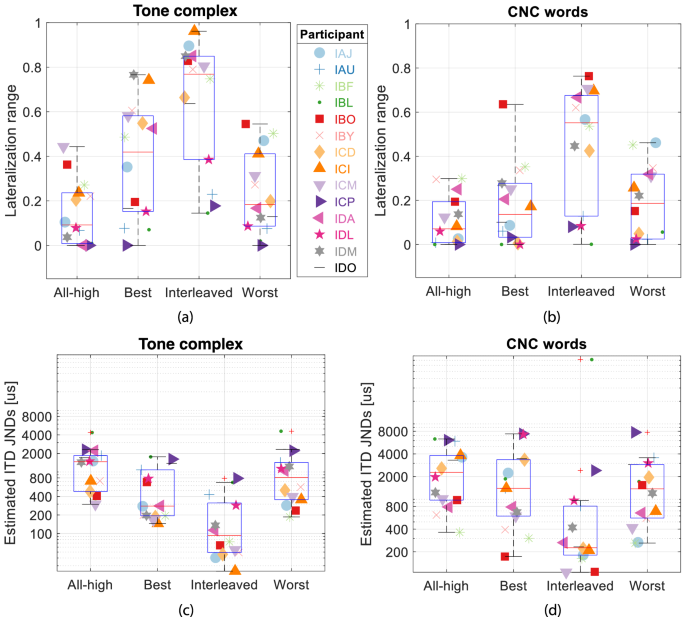
a Lateralization range for tone complex stimulus, plotted by processing strategy condition, b same as (a) but with CNC word stimulus. The lateralization range of 0 and 1 corresponds to not perceiving a change in intercranial location with ITDs and being able to use ITDs for the full range of lateralized perception, respectively. c Estimated JNDs based on lateralization performance with tone complex stimulus. d Similar to c, but with CNC word stimulus.
Table 3 Two-sided post hoc comparisons were evaluated with Estimated Marginal Means (EMM) for processing strategies with different stimulus typesLateralization range with the tone complex was significantly larger than with CNC words (EMM diff (tone - word) = 0.12, p < 0.0001), reflected by the significant main effect of stimulus type (F (1,98) = 21.23, p < 0.0001) on lateralization range. There was also a significant interaction between stimulus and stimulation strategy (F (3,98) = 2.86, p = 0.04). With the CNC word stimuli, the benefit of Best vs. Worst mixed rate strategy did not hold (EMM diff (best - worst) = −0.01, p = 1). The benefit from the Interleaved mixed rate strategy was also reduced with CNC word stimuli (EMM diff (tone – word) = 0.18, p = 0.0007), despite the statistical significance for all comparisons with other strategies (Table 3). Most participants did not benefit from their Best mixed rate strategy with speech stimuli. This was probably due to speech stimuli being more spectra-temporally sparse at the basal, high-frequency channels. Despite our best efforts to ensure stimulation across all channels by selecting CNC words that were more broadband, higher frequency channels still provided less stimulation than lower frequency channels (see Fig. 5). Note that for most participants (8 out of 14), the best ITD JNDs were measured at basal, high-frequency electrode pairs (see Fig. 2b). The lack of high frequency energy in the CNC words would mean that the low-rate stimulation at basal channels in the Best mixed rate strategy might not have been long enough in duration to provide sufficient encoding of ITDs for lateralization in most participants, which could explain the lack of benefit. In contrast, participant IBO, whose best ITD JND was measured at the apical electrode pair, showed substantial benefit with the Best mixed rate strategy (see Fig. 4 for the lateralization benefit with CNC words and Fig. 5 for an example electrodogram for CNC word stimuli for this participant).
Fig. 5: Example electrodograms of the Best mixed rate strategy for two participants (IBO and ICI) for the same CNC word.
Electrode 1 and electrode 22 correspond to the highest and lowest frequency channel, respectively. Pulses on the right and left sides are shown in red and blue, respectively. a IBO’s best ITD sensitivity was obtained with the apical-most channel (i.e., low frequency) hence low-rate stimulation was sent to electrode 22 (indicated by the sparse stimulation pattern at electrode 22). b ICI’s best-ITD-sensitivity or low-rate channel is at the basal location, but there was no stimulation energy in high-frequency channels in this example. Note that ICI did not have stimulation in channels 2, 4, 6, 8, 10 because the speech energy in those channels did not reach the threshold levels in those channels for this specific participant in this specific example. This is an example taken from the loudness balancing procedure. During this procedure, participants adjusted the overall level of the same word stimulus across all 4 stimulation strategies to ensure equal loudness across strategies. The lack of energy in these channels can also be due to down-scaling from this participant. Please also refer to Fig. 1 for an example stimulation pattern where all electrodes are stimulated.
From each individual’s lateralization responses in each test condition (stimulation strategy, stimulus type), we estimated ITD JNDs based on a d’ calculation, as shown in Fig. 4c, d. There is a significant main effect of stimulation strategy on JNDs (F (3,98) = 37.47, p < 0.0001), and stimulus type (F(1,98) = 45.406, p < 0.0001). The interaction between stimulus type and stimulation strategy did not reach statistical significance (F(3,98) = 2.51, p = 0.06). The between-condition comparisons are listed in Table 3. The individual values of ITD JND estimates are listed in Table 4.
Table 4 ITD JND estimates from lateralization performance Demographic factors and ITD sensitivityThe hypothesis of this study focused on maximizing spatial hearing benefit with a mixed rate strategy via optimization of low-rate delivery at specific cochlear locations. Here, we analyzed the relationship between demographic factors and ITD sensitivity for the following reasons: (1) as shown in Fig. 6a and b, the best ITD thresholds are predictive of performance with a mixed rate strategy, and (2) prior literature has shown that some demographic factors, including onset of hearing loss, duration of bilateral hearing loss and exposure to electrical stimulation, are related to binaural sensitivity33,54. Here, we combine prior findings with current dataset in efforts to investigate whether demographic factors could be used to predict the potential benefits from a mixed rate strategy without measuring ITD sensitivity. The data sample might not be powered sufficiently (or strictly follow the normal distribution assumption for Pearson correlation) to establish relationships between demographic factors and ITD sensitivity. For this reason, we did not perform stringent multiple comparison adjustments for this exploratory analysis. The goal here was to see if some of the previously reported trends could be seen in this analysis with this new dataset. The best ITD JNDs were negatively correlated with the age at onset of hearing loss (later the onset of loss, better the JNDs; r = −0.57, p = 0.03), and positively correlated with the duration of bilateral hearing loss before BiCIs (longer the bilateral hearing loss, worse the JNDs; r = 0.58, p = 0.03), as shown in Fig. 6c, d, respectively; but showed no association with BiCI experience (r = 0.04, p = 0.89), age at testing (r = 0.07, p = 0.80), and gap between first and second implants (r = −0.01, p = 0.96). The worst ITD JNDs were positively correlated with bilateral hearing loss before BiCIs (longer the bilateral hearing loss, worse the JNDs; r = 0.53, p = 0.05), as shown in Fig. 6e; but not with onset of hearing loss (r = −0.45, p = 0.10), experience with BiCIs (r = 0.03, p = 0.91), age at testing (r = 0.17, p = 0.56), or gap between first and second implants (r = −0.13, p = 0.67). The best and worst ITD JNDs were highly positively correlated (r = 0.92, p < 0.0001), as shown in Fig. 6f.
Fig. 6: Relationship among ITD sensitivity, lateralization range, and participant demographic factors (n = 14).
a Correlation between the Best ITD JNDs and lateralization range with tone complexes. b Correlation between the Best ITD JNDs and lateralization range with CNC words. c Correlation with Best ITD JNDs and age at onset of hearing loss. Note that all participants, except for IDO (3-year gap), started having hearing loss in both ears at the same age (see Table 1). For IDO, we chose the earlier onset for analysis. d Correlation between Best ITD JNDs and bilateral hearing loss (BHL) before BiCIs. BHL before BiCIs is the difference between the onset of hearing loss (later ear) and age at the implantation of the second CI. e Correlation between Worst ITD JNDs and BHL before BiCIs. f Correlation between Worst ITD JNDs and Best ITD JNDs. Note that the ITD values shown on the y axis are common (or base 10) logarithm-transformed values. Correlations that did not reach statistical significance are reported in text in the section titled: Demographic factors and ITD sensitivity. Note that we did not correct for multiple comparisons for this exploratory analysis for the reason stated in the text above.
DiscussionThis study aimed to understand how electrical stimulation with BiCIs can deliver binaural benefits through a more personalized approach. Specifically, we studied whether low-rate ITD cues delivered to targeted cochlear regions with the best ITD sensitivity could optimize performance with a mixed rate strategy. Based on this hypothesis, we predicted that a mixed rate strategy targeting the electrode pair with the best ITD sensitivity would outperform one targeting the electrode pair with the worst ITD sensitivity. Likewise, we expected that the mixed rate strategy with a single worst pair would result in a similar performance to a high-rate only coding strategy without any low-rate ITD cues.
The Best mixed rate strategy outperformed both the all-high and the worst mixed rate strategies. Note that the benefit from the Best mixed rate strategy over the Worst mixed rate strategy only marginally met statistical significance. The effect of the Best mixed-rate strategy was largely tempered by the results with the poorest overall performance (see Fig. 4). For instance, participants IAU, IBL, ICP, and IDL, who performed poorly with the Best mixed-rate strategy, also performed worst with the Interleaved mixed-rate strategy, whereas the other participants performed well with this strategy. If little benefit was observed when low-rate stimulation was delivered to all 5 pairs of electrodes, including the best and worst pairs, it was reasonable to see little benefit when low-rate stimulation was delivered to these electrode pairs alone. Figure 6 highlights how participants’ poor lateralization performance with the Interleaved mixed rate strategy could be predicted by the ITD JNDs overall (see Fig. 6 (a) and (b)), and how demographic factors may have contributed to poor outcomes. For IAU and ICP, both of these listeners had early onset of hearing loss before the age of 5, a trend that has been previously associated with poor ITD sensitivity52. IBL had hearing loss at the age of 12, but had the worst ITD JNDs among all participants (only one pair of electrodes was measured with an ITD JND below 800 µs). IDL had an adult onset of hearing loss, but had poor ITD JNDs overall as well (only two pairs of electrodes were measured with ITD JNDs below 800 µs). Despite the later onset of hearing loss, the poor ITD sensitivity might be due to interaural mismatch and long duration of deafness, leading to poor neural survival.
For some participants with overall good ITD sensitivity, there was little or no advantage of the Best mixed-rate strategy over the Worst strategy because their ITD JNDs were similar across all tested electrode pairs (Table 5). For example, IBF and IDO showed excellent ITD JNDs at all 5 electrode locations (below or around 100 µs), leading to very small differences between the best vs. worst ITD JNDs (52 µs and 58 µs for IBF and IDO, respectively). IAJ showed a moderate level of ITD sensitivity overall, with a difference of 184 µs between the best and worst ITD JNDs. IAJ benefited from low-rate stimulation with the best and worst pair of electrodes to a similar level, with the best pair yielding a slightly lower lateralization range. Large difference in ITD sensitivity between the best and worst pair of electrodes indeed led to a large gap in lateralization performance with the Best and Worst mixed rate strategies (see IBO, with a difference in ITD JND of 395 us between the best and worst electrode pairs).
Table 5 JNDs (in µs) at 5 electrode locations for each participantWe observed that more participants had their best ITD sensitivity measured with a single basal pair than with a single apical pair (8 out of 14) (Fig. 2). This finding was consistent with several previous studies54,57,58,59. Figure 7 (a) illustrates the lateralization range with the Best mixed rate strategy when using the tone complex stimulus, categorized by the stimulation site that received the low-rate stimulation (i.e., the electrode pair with the best ITD JND). Overall, the lateralization range was better with low-rate stimulation being sent to the basal electrode pair than the apical electrode pair (marginal statistical significance based on Mann-Whitney test: z = −1.97, p = 0.048; non-parametric test was used since data did not follow normal distribution). Poor lateralization with the apical electrode pair receiving low-rate stimulation can be explained by overall poor ITD sensitivity: three of the four participants (IAU, ICP, and IDL)’s best ITD JNDs are among the poorest (327, 214, 303 µs, respectively). However, the remaining one of the four participants, IBO, as mentioned above, showed good sensitivity to ITD with their best pair of electrodes (i.e., apical; JND = 113 µs), but still had poor lateralization when the low-rate stimulation was sent to their apical pair of electrodes. In contrast, for IBO, sending the low-rate stimulation to a basal electrode pair, which happened to be the worst electrode pair for them, resulted in a better lateralization performance than the apical electrode pair. This indicated the importance of targeting a basal electrode pair when delivering low-rate stimulation for providing pulse-timing ITDs.
Fig. 7: Lateralization performance by place of low-rate stimulation in the Best strategy.
a Lateralization range measured with the Best mixed rate strategy (stimuli: tone complex) (n = 14), grouped by the location of the low-rate stimulation in the mixed rate strategy. b Lateralization data from similar strategies published previously from the lab49. Note that only 5 participants from the current study participated in the 2023 study (these participants share the same color and shape with those in panel a); the participants who did not participate in the current study (not colored) are indicated in the legend. All three types of mixed rate strategies (i.e., with low-rate stimulation delivered to the single electrode pair at the apical, mid, and basal regions, respectively) were tested on each participant in this prior study (i.e., without customizing channel selection for low-rate stimulation). Data from panels were re-plotted here with permission from Thakkar et al., 2023, copyright Acoustical Society of America (doi: 10.1121/10.0017603). Note that although the strategies are similar to those in the current study, these mixed rate strategies in earlier studies contained only five channels, which were extended to ten in this study. In addition, these earlier studies used direct stimulation, with exact control over every aspect of the stimulus. The current study, on the other hand, manipulated the input signal on a frame-by-frame basis, which is more similar to what happens with clinical processors in real-world listening.
Replotted data from Thakkar et al. (2018)48 show a similar pattern to our findings: mixed rate strategy with low-rate stimulation allocated at the apical electrode locations led to poorer performance [see Fig. 7b]. These following participants from the current study participated in the prior study in Fig. 7b: IBF, IBY, ICD, ICI, ICP. In this prior study, all five participants included in the current study showed better performance from low-rate stimulation with a basal electrode pair compared to an apical electrode pair. Note that some studies do not suggest a place effect on ITD sensitivity35,54. This lack of effect can be explained by the differences in stimulation parameters across studies. We used a stimulation rate of 125 pps instead of 100 pps as in the previous work; we also directly paired electrodes by their numbers (e.g., electrode 4-4), without an additional pitch-matching procedure. The additional pitch-matching procedure may help reduce interaural place mismatch.
Nevertheless, the finding that participants typically show best ITD sensitivity with a basal electrode pair indicates that electrical stimulation of ITD cues might not follow the same tonotopic rule in acoustic stimulation as the TH auditory system, which is that TFS-based ITD processing is confined to the low-frequency, apical regions of the basilar membrane7,69. To explain why apical electrodes tend to have worse ITD sensitivity, we argue that neural stimulation might be less selective at the apical region due to “cross-turn” stimulation70, and that the less selective electrical stimulation is not well-tuned to appropriately stimulate neural structures that typically encode ITD information35. It might also be due to Cochlear-branded electrodes not reaching deep enough to stimulate the apical regions71, meaning that our assessment of ITD sensitivity may have been limited to the generally more basal regions. Hence, the variations in ITD sensitivity observed may largely reflect differences in neural survival and place matching. Basal electrodes with the same number are more likely to stimulate corresponding cochlear locations across ears, as they are easier to place consistently. In contrast, deeper (more apical) electrodes are more susceptible to placement variability—such as bends or differing distances from cochlear walls—making precise place matching across ears more challenging. This might help explain why MED-EL’s FS-strategy family—launched in 200639] and uniquely designed to encode TFS by assigning low-rate stimulation to low-frequency, apical channels—has not shown consistent speech-in-noise hearing benefits. While some studies have shown benefits in spatial hearing72 and overall speech-in-noise hearing73,74, others, such as Zirn et al.41, 2016, do not show a consistent benefit for all CI listeners. These mixed results may stem from the relatively poorer sensitivity to ITDs with the low-frequency, apical stimulation channels, as shown in this study.
We evaluated mixed-rate strategies with speech stimuli, which offered more temporal and spectral modulations than a fixed-duration, steady-state tone complex. The benefits of lateralization from the Best mixed rate strategy with a relatively simple stimulus did not hold with speech stimuli. For both stimulus types, the Interleaved mixed rate strategy outperformed all other conditions, which was expected, considering half of all channels were reserved for low-rate stimulation. This suggests that more than one low-rate channel might be necessary for more redundancy, especially when the stimuli are more spectral-temporally dynamic, such as speech75,76. Even with the tone complex stimulus, we observed that while IBF and IDO showed good ITD sensitivity overall and benefited from the Interleaved mixed rate strategy, only IBF benefited from low-rate stimulation with a single electrode pair. This again indicates that more than one pair of electrodes might be needed to benefit from a mixed rate strategy. With speech stimuli, the ITD cue was perhaps not consistently present due to the temporal modulations inherent to speech or lack of stimulation energy at high-frequency channels (in case high-frequency, basal channels were selected for low-rate stimulation in the “Best” strategy). Considering that the best ITD sensitivity has usually been observed with basal-most channels, this factor should be considered when selecting channels for low-rate stimulation based on ITD sensitivity. Nevertheless, real-world communication typically involves listening to running speech instead of single-syllable words such as those tested here. A running speech stimulus that consists of several words might offer more opportunities for stimulation at basal, high-frequency channels. For instance, amplitude modulations in speech stimuli can introduce envelope-based ITD cues in addition to the pulse-timing or TFS ITD cues. Combining TFS and ENV cues could potentially take advantage of an individual’s better sensitivity to ENV ITDs at higher clinical stimulation rates35,77, despite the relatively larger strength of pulse timing cues78 at the rates used in this study. When ENV and pulse-timing ITDs were combined in Dennison et al. (2024), there was no difference in lateralization, suggesting that listeners can combine the two cues without a degradation in performance. As mentioned earlier, while Interleaved mixed rate strategy leads to the best lateralization performance, too many low-rate channels will be problematic in terms of compromising speech intelligibility31,32. Although we did not test speech intelligibility in this study due to time constraints, participants consistently reported not liking the sound quality of the Interleaved strategy, especially during lateralization testing with speech stimuli, despite better lateralization performance than other strategies. In summary, an optimal number of channels reserved for low-rate stimulation, between single and half of all channels, might be key to maximizing the benefits of a mixed rate strategy, especially with speech sounds.
In addition to guiding the channel selection for low-rate stimulation, overall ITD sensitivity predicted a participant’s performance with a mixed rate strategy, shown by the correlations between the best ITD JND and lateralization range in Fig. 6. We attribute the moderate correlation between discrimination thresholds and lateralization range to the fact that ITD discrimination and lateralization are distinctly different tasks (see the description of the tasks in both Results and Methods sections). Nevertheless, these correlations suggested that ITD sensitivity can potentially be used in clinics as a guide to determine if a patient could benefit from mixed-rate stimulation. However, if a participant does not show measurable ITD sensitivity, rehabilitative perceptual training could potentially help improve binaural hearing abilities79,80,81, although the extent to which that occurs remains to be better understood. We also found that demographic factors predicted overall ITD sensitivity, consistent with some prior reports showing the effects of early onset of hearing loss52,54 and the moderating effect between years of bilateral deprivation and experience with CIs54. Findings in other species are consistent with our findings. Chung et al. (2019)81 showed via single-neuron recordings from the inferior colliculus (IC) that neonatally deafened rabbits had fewer neurons that synchronized to pulse trains and showed significant ITD sensitivity when compared to adult-deafened animals. Behaviorally, Isaiah et al. (2014)80 showed that ferrets with early-onset hearing loss showed poor auditory localization performance. Although more evidence from a larger population is needed, this means that demographic factors could potentially be used to predict whether a listener could benefit from a mixed-rate strategy without measuring ITD sensitivity. For example, as mentioned above and shown in Fig. 4, participants IAU, IBL, and ICP experienced early onset of hearing loss, and showed poor ITD JNDs overall, and demonstrated little benefit from low-rate stimulation even with the Interleaved mixed rate strategy. Notably, the latest animal studies demonstrated measurable ITD sensitivity despite a lack of early hearing experience, through both neurophysiological and behavioral experiments43,44,82,83. These findings suggest that the relationship between auditory experience and ITD sensitivity is more complex than previously thought and highlight the need for further investigation in this area.
One limitation of this study was that we evaluated ITD sensitivity at only five locations along the electrode array, which may not capture full variability across the entire cochlear array. However, this should be less of a concern because we are more interested in the relative instead of the absolute effect of best vs. worst. In addition, while we would have ideally sampled more electrode locations, we had to balance this with practical constraints, particularly the limited time available for testing. Another limitation of this study is the controlled laboratory setting in which the ILD cues were minimized from the stimuli. Therefore, the perceptual results we reported here reflect lateralization performance when participants were “forced” to use ITD cues in the absence of ILD cues. With clinical processors, which do not preserve TFS-based ITD cues, BiCI listeners primarily rely on ILD cues for sound source localization. Real-world listening conditions, where ILD and ITD cues coexist, might yield different outcomes. There might be a perceptual dominance from ILD cues even when ITD cues are provided through a mixed rate strategy. Our goal was not to claim immediate clinical applicability but rather to demonstrate the feasibility and potential benefits of individualized coding strategies using controlled experimental conditions. Future research could explore the long-term adaptability of patients to mixed rate strategies in diverse auditory environments, potentially examining the interaction between ITD and ILD cues under dynamic listening conditions. One immediate next step is to evaluate the mixed rate strategies examined in this study in free-field localization experiments, where both ITD and ILD cues are available, as was demonstrated in Borjigin et al. (2025)84. Another direction is to assess the benefits of the mixed rate strategy beyond spatial hearing—such as its potential effects on listening effort—given that low-frequency TFS sensitivity has been recently linked to reduced listening effort84.
ConclusionIn summary, while it is important to target the electrode location with the best ITD sensitivity for low-rate stimulation, we also show that most participants show the best ITD sensitivity when low-rate stimulation is provided to basal electrode pairs. For maximum benefit of a mixed rate strategy with more natural stimuli such as speech, more than one channel should be reserved for low-rate stimulation, or the ITD information should be dynamically encoded in a channel with energy to guarantee the delivery of this information. If two channels were to be selected for low-rate stimulation, one should be at the basal locations, where ITD sensitivity is likely to be the best, although speech energy tends to be less in those channels. The assignment of low-rate stimulation to basal electrode pairs has the benefit of minimizing the negative impact from introducing low-rate stimulation on speech understanding31,32, considering most of the speech energy is in the range from 200 to 3500 Hz, not so much in the basal-most channels85. The other electrode location selection should probably avoid the apical region, where ITD sensitivity may be poor. Data from Ihlefeld et al. (2014) showed that overall ITD sensitivity from multi-electrode stimulation is typically degraded by the ITD sensitivity of the poorer electrode pair86. However, performance with the mixed rate strategy might benefit from selecting a site where speech energy is typically more dominant (i.e., somewhat away from the basal most channel). These findings could inform the development of more optimized CI programming strategies, potentially leading to improved outcomes for BiCI listeners in both speech understanding and spatial hearing, thereby enhancing their overall quality of life.
Fig. 8: Lateralization with tone complexes (n = 14).
Each row contains data for 4 strategies from an individual. Light grey dots are individual response at each ITD presented. The cross at each ITD is the mean of the individual dots, while the error bar is 1 standard deviation. The red line is the fit of means at all ITDs presented. R, C, and L on the y axis represent right, center, and left, and map to ITDs of 800, 0, and –800 µs, respectively.
Fig. 9: Lateralization with CNC words (n = 14).
Each row contains data for 4 strategies from an individual. Details of the figure are the same as those described in Fig. 8 caption.
Data availabilityThe data that support the findings of this study are available on Open Science Framework (https://osf.io/tqhup/overview?view_only=d46aca36d2dd4c38970f4aa5a1d31508). Source data underlying the Figs. 1–9 can also be accessed from Supplementary Data 1–6.
Code availabilityThe scripts for data analyses and step-by-step instructions can be accessed on the Open Science Framework (https://osf.io/k6rhx/overview?view_only=161fc7fa3fb849b29fb71c753f68c631).
ReferencesBlauert, J. Spatial Hearing: The Psychophysics of Human Sound Localization. MIT Press (1997).
Middlebrooks, J. C. & Green, D. M. Sound localization by human listeners. Annu. Rev. Psychol. 42, 135–159 (1991).
Stecker, C. & Gallun, F. Binaural Hearing, Sound Localization, and Spatial Hearing. Translational perspectives in Auditory Neuroscience: Normal Aspects of Hearing. In: Translational Perspectives in Auditory Neuroscience. Plural Publishing, Incorporated; (2012).
Yost, W. A. & Hafter, E. R. Lateralization. In: Yost WA, Gourevitch G, eds. Directional Hearing. Springer 49–84. (1987).
Rayleigh, Lord. On the perception of the direction of sound. Proc. R. Soc. Lond. Ser. A Contain. Pap. A Math. Phys. Character 83, 61–64 (1909).
Smith, Z. M., Delgutte, B. & Oxenham, A. J. Chimaeric sounds reveal dichotomies in auditory perception. Nature 416, 87 (2002).
Brughera, A., Dunai, L. & Hartmann, W. M. Human interaural time difference thresholds for sine tones: The high-frequency limit. J. Acoust. Soc. Am. 133, 2839–2855 (2013).
Macpherson, E. A. & Middlebrooks, J. C. Listener weighting of cues for lateral angle: The duplex theory of sound localization revisited. J. Acoust. Soc. Am. 111, 2219–2236 (2002).
Brown, K. D. & Balkany, T. J. Benefits of bilateral cochlear implantation: a review. Curr. Opin. Otolaryngol. Head. Neck Surg. 15, 315 (2007).
Kan, A. & Litovsky, R. Y. Binaural hearing with electrical stimulation. Hear. Res. 322, 127–137 (2015).
van Hoesel, R. J. M. & Tyler, R. S. Speech perception, localization, and lateralization with bilateral cochlear implants. J. Acoust. Soc. Am. 113, 1617–1630 (2003).
Grantham, D. W., Ashmead, D. H., Ricketts, T. A., Labadie, R. F. & Haynes, D. S. Horizontal-plane localization of noise and speech signals by postlingually deafened adults fitted with bilateral cochlear implants*. Ear Hear. 28, 524 (2007).
Litovsky, R., Parkinson, A., Arcaroli, J. & Sammeth, C. Simultaneous bilateral cochlear implantation in adults: a multicenter clinical study. Ear Hear 27, 714–731 (2006).
Litovsky, R. Y., Parkinson, A. & Arcaroli, J. Spatial hearing and speech intelligibility in bilateral cochlear implant users. Ear Hear. 30, 419 (2009).
Hughes, K. C. & Galvin, K. L. Measuring listening effort expended by adolescents and young adults with unilateral or bilateral cochlear implants or normal hearing. Cochlear Implants Int. 14, 121–129 (2013).
Anderson, S. R. et al. Sound source localization patterns and bilateral cochlear implants: Age at onset of deafness effects. PLOS ONE 17, e0263516 (2022).
Beijen, J. W., Snik, A. F. M. & Mylanus, E. A. M. Sound localization ability of young children with bilateral cochlear implants. Otol. Neurotol. 28, 479 (2007).
Verschuur, C. A., Lutman, M. E., Ramsden, R., Greenham, P. & O’Driscoll, M. Auditory localization abilities in bilateral cochlear implant recipients. Otol. Neurotol. 26, 965 (2005).
Zheng, Y., Godar, S. P. & Litovsky, R. Y. Development of sound localization strategies in children with bilateral cochlear implants. PLOS ONE 10, e0135790 (2015).
Litovsky, R. Y. Spatial release from masking. Acou Today 8, 18 (2012).
Loizou, P. C. et al. Speech recognition by bilateral cochlear implant users in a cocktail-party setting. J. Acoust. Soc. Am. 125, 372–383 (2009).
Ricketts, T. A., Grantham, D. W., Ashmead, D. H., Haynes, D. S. & Labadie, R. F. Speech recognition for unilateral and bilateral cochlear implant modes in the presence of uncorrelated noise sources. Ear Hear. 27, 763 (2006).
Dennison, S. R., Thakkar, T., Kan, A. & Litovsky, R. Y. Lateralization of binaural envelope cues measured with a mobile cochlear-implant research processor. J. Acoust. Soc. Am. 153, 3543–3558 (2023).
Jones, H., Kan, A. & Litovsky, R. Y. Comparing sound localization deficits in bilateral cochlear-implant users and vocoder simulations with normal-hearing listeners. Trends Hear. 18. https://doi.org/10.1177/2331216514554574 (2024).
Wightman, F. L. & Kistler, D. J. The dominant role of low-frequency interaural time differences in sound localization. J. Acoust. Soc. Am. 91, 1648–1661 (1992).
Aronoff, J. M. et al. The use of interaural time and level difference cues by bilateral cochlear implant users. J. Acoust. Soc. Am. 127, EL87–EL92 (2010).
Dennison, S. R., Jones, H. G., Kan, A. & Litovsky, R. Y. The impact of synchronized cochlear implant sampling and stimulation on free-field spatial hearing outcomes: comparing the ciPDA research processor to clinical processors. Ear Hear. 43, 1262–1272 (2022).
Kuhn, G. F. Model for the interaural time differences in the azimuthal plane. J. Acoust. Soc. Am. 62, 157–167 (1977).
Moller, H., Sorensen, M. F., Hammershoi, D., Jensen, C. B. Head-related transfer functions of human subjects. J. Audio Eng Soc. 43, (1995).
R.S LROMP. XII. On our perception of sound direction. The London, Edinburgh, and Dublin Philosophical Magazine and Journal of Science. Published online February 1. https://doi.org/10.1080/14786440709463595
Loizou, P. C., Poroy, O. & Dorman, M. The effect of parametric variations of cochlear implant processors on speech understanding. J. Acoust. Soc. Am. 108, 790–802 (2000).
Friesen, L. M., Shannon, R. V. & Cruz, R. J. Effects of stimulation rate on speech recognition with cochlear implants. AUD 10, 169–184 (2005).
Anderson, S. R., Easter, K. & Goupell, M. J. Effects of rate and age in processing interaural time and level differences in normal-hearing and bilateral cochlear-implant listenersa). J. Acoust. Soc. Am. 146, 3232–3254 (2019).
Laback, B., Majdak, P. & Baumgartner, W. D. Lateralization discrimination of interaural time delays in four-pulse sequences in electric and acoustic hearing. J. Acoust. Soc. Am. 121, 2182–2191 (2007).
Laback, B., Egger, K. & Majdak, P. Perception and coding of interaural time differences with bilateral cochlear implants. Hear. Res. 322, 138–150 (2015).
van Hoesel, R. J. M., Jones, G. L. & Litovsky, R. Y. Interaural time-delay sensitivity in bilateral cochlear implant users: effects of pulse rate, modulation rate, and place of stimulation. JARO 10, 557–567 (2009).
Carlyon, R. P. et al. Limitations on temporal processing by cochlear implant users: a compilation of viewpoints. Trends Hearing 29, 23312165251317006 (2025).
Ihlefeld, A., Carlyon, R. P., Kan, A., Churchill, T. H. & Litovsky, R. Y. Limitations on monaural and binaural temporal processing in bilateral cochlear implant listeners. J. Assoc. Res. Otolaryngol. 16, 641–652 (2015).
Riss, D. et al. FS4, FS4-p, and FSP: A 4-month crossover study of 3 fine structure sound-coding strategies. Ear Hear. 35, e272–e281 (2014).
Ausili, S. A. et al. Spatial Hearing by Bilateral Cochlear Implant Users With Temporal Fine-Structure Processing. Front. Neurol. 11, https://doi.org/10.3389/fneur.2020.00915 (2020).
Zirn, S., Arndt, S., Aschendorff, A., Laszig, R. & Wesarg, T. Perception of interaural phase differences with envelope and fine structure coding strategies in bilateral cochlear implant users. Trends Hear. 20, 2331216516665608 (2016).
Eklöf, M. & Tideholm, B. The choice of stimulation strategy affects the ability to detect pure tone inter-aural time differences in children with early bilateral cochlear implantation. Acta Oto-Laryngol. 138, 554–561 (2018).
Buck, A. N., Buchholz, S., Schnupp, J. W. & Rosskothen-Kuhl, N. Interaural time difference sensitivity under binaural cochlear implant stimulation persists at high pulse rates up to 900 pps. Sci. Rep. 13, 3785 (2023).
Schnupp, J. W. H. et al. Pulse timing dominates binaural hearing with cochlear implants. Proc. Natl. Acad. Sci. 122, e2416697122 (2025).
Goupell, M. J., Laback, B. & Majdak, P. Enhancing sensitivity to interaural time differences at high modulation rates by introducing temporal jitter. J. Acoust. Soc. Am. 126, 2511–2521 (2009).
Laback, B. & Majdak, P. Binaural jitter improves interaural time-difference sensitivity of cochlear implantees at high pulse rates. Proc. Natl. Acad. Sci. 105, 814–817 (2008).
Churchill, T. H., Kan, A., Goupell, M. J. & Litovsky, R. Y. Spatial hearing benefits demonstrated with presentation of acoustic temporal fine structure cues in bilateral cochlear implant listeners. J. Acoust. Soc. Am. 136, 1246–1256 (2014).
Thakkar, T., Kan, A., Jones, H. G. & Litovsky, R. Y. Mixed stimulation rates to improve sensitivity of interaural timing differences in bilateral cochlear implant listeners. J. Acoust. Soc. Am. 143, 1428–1440 (2018).
Thakkar, T., Kan, A. & Litovsky, R. Y. Lateralization of interaural time differences with mixed rates of stimulation in bilateral cochlear implant listeners. J. Acoust. Soc. Am. 153, 1912–1923 (2023).
Dennison, S. R. et al. A mixed-rate strategy on a bilaterally-synchronized cochlear implant processor offering the opportunity to provide both speech understanding and interaural time difference cues. J. Clin. Med. 13, 7 (2024).
Ehlers, E., Goupell, M. J., Zheng, Y., Godar, S. P. & Litovsky, R. Y. Binaural sensitivity in children who use bilateral cochlear implants. J. Acoust. Soc. Am. 141, 4264–4277 (2017).
Litovsky, R. Y., Jones, G. L., Agrawal, S. & van Hoesel, R. Effect of age at onset of deafness on binaural sensitivity in electric hearing in humans. J. Acoust. Soc. Am. 127, 400–414 (2010).
Litovsky, R. Y. et al. Studies on bilateral cochlear implants at the university of Wisconsin’s binaural hearing and speech laboratory. J. Am. Acad. Audio. 23, 476–494 (2012).
Thakkar, T., Anderson, S. R., Kan, A. & Litovsky, R. Y. Evaluating the impact of age, acoustic exposure, and electrical stimulation on binaural sensitivity in adult bilateral cochlear implant patients. Brain Sci. 10, 6 (2020).
Anderson, S. R., Gallun, F. J. & Litovsky, R. Y. Interaural asymmetry of dynamic range: Abnormal fusion, bilateral interference, and shifts in attention. Front. Neurosci. 16, https://doi.org/10.3389/fnins.2022.1018190 (2023).
Verschooten, E. et al. The upper frequency limit for the use of phase locking to code temporal fine structure in humans: A compilation of viewpoints. Hear. Res. 377, 109–121 (2019).
Best, V., Laback, B. & Majdak, P. Binaural interference in bilateral cochlear-implant listeners. J. Acoust. Soc. Am. 130, 2939–2950 (2011).
Egger, K., Laback, B., Majdak, P. Across-electrode integration of interaural time difference in bilateral cochlear implant listeners. (2014).
Kan, A., Jones, H. & Litovsky, R. Issues in binaural hearing in bilateral cochlear implant users. Proc. Meet. Acoust. 19, 050049 (2013).
Fishman, K. E., Shannon, R. V. & Slattery, W. H. Speech recognition as a function of the number of electrodes used in the SPEAK cochlear implant speech processor. J. Speech, Lang. Hear. Res. 40, 1201–1215 (1997).
Holmes, A. E., Kemker, E. J. & Merwin, G. E. The effects of varying the number of cochlear implant electrodes on speech perception. Otol. Neurotol. 8, 240 (1987).
Litovsky, R. Y., Goupell, M. J., Kan, A. & Landsberger, D. M. Use of research interfaces for psychophysical studies with cochlear-implant users. Trends Hear. 21, 2331216517736464 (2017).
Wilson, B. S. et al. Better speech recognition with cochlear implants. Nature 352, 236–238 (1991).
Ghosh, R., Ali, H. & Hansen, J. H. L. CCi-MOBILE: a portable real time speech processing platform for cochlear implant and hearing research. IEEE Trans. Biomed. Eng. 69, 1251–1263 (2022).
Ghosh, R. & Hansen, J. H. L. Bilateral cochlear implant processing of coding strategies with CCi-MOBILE, an open-source research platform. IEEE/ACM Trans. Audio, Speech Lang. Process. 31, 1839–1850 (2023).
Borjigin, A., Dennison, S. R., Kan, A. & Litovsky, R. Y. Localization performance of cochlear implant users with a real-time bilaterally-synchronized sound coding strategy that provides explicit interaural timing cues with mixed rates of stimulation. Front. Neurosci. 19, https://doi.org/10.3389/fnins.2025.1682452 (2025).
Wichmann, F. A. & Hill, N. J. The psychometric function: II. Bootstrap-based confidence intervals and sampling. Percept. Psychophys. 63, 1314–1329 (2001).
Kuss, M., Jäkel, F. & Wichmann, F. A. Bayesian inference for psychometric functions. J. Vis. 5, 8–8 (2005).
Hughes, J. W. The upper frequency limit for the binaural localization of a pure tone by phase difference. Proc. R. Soc. Lond. Ser. B - Biol. Sci. 128, 293–305 (1940).
Briaire, J. J. & Frijns, J. H. M. The consequences of neural degeneration regarding optimal cochlear implant position in scala tympani: a model approach. Hear Res 214, 17–27 (2006).
Dhanasingh, A. & Jolly, C. An overview of cochlear implant electrode array designs. Hear. Res. 356, 93–103 (2017).
Fischer, T. et al. Effects of temporal fine structure preservation on spatial hearing in bilateral cochlear implant users. J. Acoust. Soc. Am. 150, 673–686 (2021).
Lorens, A., Zgoda, M., Obrycka, A. & Skarżynski, H. Fine Structure Processing improves speech perception as well as objective and subjective benefits in pediatric MED-EL COMBI 40+ users. Int. J. Pediatr. Otorhinolaryngol. 74, 1372–1378 (2010).
Vermeire, K., Punte, A. K., Heyning, P. V. & de Better speech recognition in noise with the fine structure processing coding strategy. ORL 72, 305–311 (2010).
Ding, N. et al. Temporal modulations in speech and music. Neurosci. Biobehav. Rev. 81, 181–187 (2017).
Elliott, T. M. & Theunissen, F. E. The modulation transfer function for speech intelligibility. PLOS Comput. Biol. 5, e1000302 (2009).
Noel, V. A. & Eddington, D. K. Sensitivity of bilateral cochlear implant users to fine-structure and envelope interaural time differences. J. Acoust. Soc. Am. 133, 2314–2328 (2013).
Majdak, P., Laback, B. & Baumgartner, W. D. Effects of interaural time differences in fine structure and envelope on lateral discrimination in electric hearing. J. Acoust. Soc. Am. 120, 2190–2201 (2006).
Coudert, A., Verdelet, G., Reilly, K. T., Truy, E. & Gaveau, V. Intensive training of spatial hearing promotes auditory abilities of bilateral cochlear implant adults: a pilot study. Ear Hear. 44, 61 (2023).
Isaiah, A., Vongpaisal, T., King, A. J. & Hartley, D. E. H. Multisensory training improves auditory spatial processing following bilateral cochlear implantation. J. Neurosci. 34, 11119–11130 (2014).
Chung, Y., Buechel, B. D., Sunwoo, W., Wagner, J. D. & Delgutte, B. Neural ITD sensitivity and temporal coding with cochlear implants in an animal model of early-onset deafness. JARO 20, 37–56 (2019).
Buck, A. N., Rosskothen-Kuhl, N. & Schnupp, J. W. Sensitivity to interaural time differences in the inferior colliculus of cochlear implanted rats with or without hearing experience. Hear. Res. 408, 108305 (2021).
Rosskothen-Kuhl, N., Buck, A. N., Li, K. & Schnupp, J. W. Microsecond interaural time difference discrimination restored by cochlear implants after neonatal deafness. eLife 10, e59300 (2021).
Borjigin, A. & Bharadwaj, H. M. Individual differences elucidate the perceptual benefits associated with robust temporal fine-structure processing. Proc. Natl. Acad. Sci. 122, e2317152121 (2025).
Sobolewski, J. S. Data Transmission Media. In: Meyers RA, ed. Encyclopedia of Physical Science and Technology (Third Edition). Academic Press 277–303 (2003).
Ihlefeld, A., Kan, A. & Litovsky, R. Y. Across-frequency combination of interaural time difference in bilateral cochlear implant listeners. Front. Syst. Neurosci. 8, https://doi.org/10.3389/fnsys.2014.00022 (2014).
The authors declare that financial support was received for the research and publication of this article. This work was supported by NIH–NIDCD R01DC016839 (J. L. Hansen, R. Y. Litovsky, M. A. Svirsky), NIH–NIDCD R01DC020355 (R. Y. Litovsky), and in part by a core grant from the NIH–NICHD (U54 HD090256 to the Waisman Center).
Author informationAuthors and AffiliationsUniversity of Wisconsin-Madison, Madison, WI, USA
Agudemu Borjigin & Ruth Y. Litovsky
University of Utah, Salt Lake City, UT, USA
Agudemu Borjigin
MED-EL Corporation, Durham, NC, USA
Stephen R. Dennison
University of Wisconsin-La Crosse, La Crosse, WI, USA
Tanvi Thakkar
Macquarie University, Sydney, NSW, Australia
Alan Kan
A.B.: Conceptualization, Investigation, Methodology, Software, Supervision, Project administration, Data collection and curation, Formal analysis, Visualization, Validation, Writing – original draft, Writing review & editing. S.R.D.: Conceptualization, Investigation, Methodology, Validation, Writing review & editing. T.T.: Conceptualization, Investigation, Writing review & editing. A.K.: Conceptualization, Investigation, Writing – review & editing. R.Y.L.: Conceptualization, Investigation, Funding acquisition, Supervision, Writing – review & editing.
Corresponding author Ethics declarationsCompeting interestsSRD is an employee of MED-EL US, a distributor of cochlear implants. AK holds shares in Cochlear Ltd. All other authors declare that they have no financial or non-financial competing interests that could be construed as a potential conflict of interest.
Peer reviewPeer review informationCommunications Medicine thanks the anonymous reviewers for their contribution to the peer review of this work. A peer review file is available.
Additional informationPublisher’s note Springer Nature remains neutral with regard to jurisdictional claims in published maps and institutional affiliations.
)
Due to demand, we’ve reopened abstract submissions for a limited time.
Submit your research for the opportunity to present your work to the wider conference community and contribute to the conversations shaping the field.
Submit your abstract by 1 October.